


The Art of Gathering Around Food
Just a year after graduating from hospitality school in Manipal, Armaan started building Khoj, a multidisciplinary dining experience sitting at the intersection of food, art, and culture. Starting with supper clubs and years of chasing experience over money has now evolved into an artist-led space where food becomes a medium for storytelling, connection, and self expression. Through intimate dinners, shared conversations, and immersive experiences, Khoj invites people to arrive exactly as they are and leave a little more open than before.
What is it that you do, and what draws you to it?
‘I graduated from college just last year and joined Farmlore in Bangalore for a three month internship. At the time, my plan was simple: travel, learn, and absorb as much as I could. I was never very profit driven because hospitality as an industry doesn’t really pay much, and honestly, that didn’t bother me because I genuinely loved what I was doing.
But things shifted after my family went through a financial crisis. I had to rethink what sustainability looked like for me. I moved from only focusing on restaurants to figuring out how to financially support myself through my work. I used to host supper clubs during my college days in Manipal to fund little things like trips or personal expenses.
I started Khoj which feels difficult to define in just one way. At its core, it’s a multidisciplinary dining experience that exists at the intersection of food, art, and culture. But beyond that, it has also grown into an artist collective, a space where emerging creatives can experiment, collaborate, and put themselves out there without everything needing to feel transactional.
What really draws me to this is people and food, and the ability to tell stories through experiences. I love watching people slowly become themselves around a table. One of the core ideas at Khoj is that there are no rigid rules around dining. It doesn’t matter how you dress, sit, eat, or speak. You can arrive exactly as you are. We’ve hosted around twelve tables so far, and even when people begin the night reserved or unfamiliar with one another, they slowly open up. Through small icebreakers and shared experiences, people end up becoming the most honest versions of themselves by the end of the dinner.’
It’s not the most typical path for someone your age, what led you here?
‘I started working when I was around fifteen, and that’s when I was first introduced to the world of fine dining events. Back then, I would assist chefs during pop ups across Kochi and Bangalore. This started when I was in eleventh grade, and even throughout college, I kept returning to it. I would literally save up attendance just so I could travel and work wherever a chef needed help. Those experiences shaped me a lot because every kitchen, every event, taught me something different. The styles changed, but the core of running an operation always stayed the same. Starting Khoj itself was honestly a split second decision. It happened over the course of three days. Before this, I already ran an Instagram page that hosted multiple IPs and formats, and I still continue to do that. But I didn’t want Khoj to become just another format or casual extension of that work because Khoj felt deeply personal to me. Every dinner carried pieces of who I am and how I see the world, so I knew I wanted to build it seriously. The worst case scenario was that it wouldn’t work out, and I could always restart somewhere else.
Before Khoj officially existed, I had done a private wedding dinner for a couple who met on Bumble. That was probably my first real dining experience as a host. I cooked for them right after their wedding ceremony, serving around twenty five guests. Even today, I think food is one of the most personal things people can trust you with. So the fact that someone trusted me with something as intimate as a wedding dinner still feels unreal to me.
What’s funny is that my first dinner was supposed to happen on a Friday, and until Thursday evening, we hadn’t sold a single ticket. I was stressed because people had travelled from Bangalore to help me, and I felt responsible for their time and effort. So that night, the chef and I decided we would just go out and try selling tickets ourselves. We went around Fort Kochi near the Biennale venues, approaching strangers and introducing them to Khoj. It genuinely felt like rejection therapy. But eventually, two Danish artists visiting Kochi for the Biennale trusted us enough to book seats. Then another group joined, and then another table after that. By Thursday night itself, both Day One and Day Two were sold out.
We would hand diners a pen and paper at the end of the experience and ask them to be honest with us. Since I was just starting out, I wanted people to tell me what worked and what didn’t. If multiple people pointed out the same thing, I knew it was something I needed to improve. I never wanted feedback to be sugar coated just to make me feel better. I wanted it to help me grow, both as a host and as a person.’
When you talk about collaborating with artists, what does that actually look like in practice?
‘We try to create opportunities for artists in whatever way we can, whether that’s through our dinners or collaborations around them. We don’t limit ourselves to one kind of artist or one form of expression. If you’re building something, exploring an idea, or simply trying to find your voice, there’s space for you at Khoj.’


When you’re planning a dinner in a new city, what kind of observations or research do you begin with?
‘Before planning a dinner in any new city, I spend a lot of time understanding the place itself, its history, cultural values, people, and the stories that shape it. That’s usually my first layer of research before I even begin thinking about the menu or the experience. I also spend a lot of time looking into the local creative community. Honestly, a lot of it begins with doom scrolling, going through artist profiles, checking mutuals, and understanding what kind of voices are emerging from that city. In Mumbai, for example, we came across rappers whose work reflected the realities of growing up in the slums. Those are the kinds of artists we love collaborating with because their stories can naturally shape the direction of a dinner.
From there, we start building connections between food, culture, and storytelling. We think about what ingredients feel local, what emotions or memories people associate with the place, and what kind of stories we can tell through the experience. For us, there’s a very fine line between being intentional and becoming pretentious, and we’re constantly aware of that balance. We never want the experience to feel performative without genuine understanding behind it.
A huge part of our process is also understanding the city through locals rather than just relying on internet guides. We usually spend around fifteen to twenty days in a place before finalising a concept because locals always understand a city better than any curated online recommendation ever can. They’ve lived through its transitions, traditions, and changes. That research eventually translates into every detail of the dinner. If we’re bringing a Kochi inspired experience to Bangalore, for instance, we want people to feel Kochi through every element, the scent, the music, the ingredients, even the textures and materials used in the space. We pay attention to every small detail because the goal is to create something immersive rather than just serve food.
Coming from Kochi also shapes the way I think about food and culture. Kochi itself is built on layers of migration and exchange, so our food naturally carries influences from multiple places. That’s why people from very different regions can still find points of connection in the stories we tell through our dinners. For one of our desserts, we used cacao husk, something usually discarded as waste, to talk about labour, extraction, and sustainability within the chocolate industry. It became a way to question why we only value the polished final product while ignoring everything left behind in the process. We also try to collaborate with and highlight local producers wherever we go. In Kochi, for example, we worked with a local gourmet chocolate brand because supporting smaller, local ecosystems is just as important to us as the dinner itself.’

When strangers come together at your table, how does food help them open up and share stories?
‘With our dinner format, we’ve always tried to keep things very open and relatable because the entire experience is built around expression and interpretation. One of the things we do is give every guest a pen and paper during the dinner. It allows them to respond to the food in their own way and reflect on how differently people experience the same thing. I still have around eighty two of those response sheets, and what’s fascinating is that no two people have interpreted the dinner in the same way.
Another thing we do is never tell guests exactly what they’re eating. We serve the course, let them taste it, guess the ingredients, and write about what it reminds them of. For example, we once served fermented rice water with ginger skin. It reminded them of their grandmother or childhood memories, and instantly that became a conversation starter at the table.
At the same time, the interpretations can go to completely different extremes. We once had a guest connect one of our courses to ideas around labour, trade systems, sustainability, and even geopolitical conflict. So while one person is talking about nostalgia and home, another person is analysing larger political structures through the exact same dish. That contrast is what makes the dinners so interesting. We also love surprising people through ingredients and perception. We once made a puree out of a banana stem that most people thought was cauliflower. Another course was actually slow cooked and charred cabbage, but almost everyone guessed caramelised onion. Only one person identified it correctly. Those small twists keep people curious throughout the meal, and the conversations continue naturally until the next course arrives.’
If we were to experience one of your dinners, what would that feel like from start to finish?
‘I think the experience would feel very homely at its core, even though it’s also deeply multi-sensory. I know those two words don’t naturally sit together, but that’s honestly the closest way to describe it.
A lot of the dinners are built around personal emotions and experiences, so sometimes they can feel emotionally heavy. Certain courses come from places of grief, loss, or moments from my own life, and people often end up sitting with emotions they weren’t necessarily expecting when they arrived. I wouldn’t call it uncomfortable, but it can feel slightly unsettling in a reflective way.
For us, the experience has never been just about the food. Every single detail matters because we want people to leave with multiple emotional and sensory reference points attached to the dinner. That’s why we work with music producers, projection artists, and visual designers to shape the atmosphere around the meal.
We think about everything very intentionally, the scent being burned during each course, the flowers on the table, the lighting, the projections, the soundscape, the colour palette, the crockery, the cutlery, even the material a dish is served on. Sometimes we serve courses on tiles or other local materials, and one of our courses is served on a banana flower itself.’
How do you manage it all?
‘Honestly, once something gets into my head, I just keep going until it’s done. It’s probably not the healthiest way to work, but that’s how I function right now. If I could afford to hire more people, I would, but I never want to underpay anyone or bargain unfairly because I know what it feels like to be on the other side of that. The last few years of my life have really shaped that perspective.’

We came across your idea of turning a literature piece into a menu — how did that come about?
‘There was this food and culture festival happening in Kochi, and we were invited to be a part of its first edition. We had been discussing ideas for a while, but the actual dinner plan only became concrete about a week before the event because of LPG shortage issues and other logistical problems. What made it even more intense was that I was handling almost everything alone. The concept was ready, the menu existed on paper, but I had never actually cooked any of those dishes before. I hadn’t even done trials. So on the day of the event, I technically still didn’t fully know what I was serving. I had ideas in my head, but they were still very abstract until the last moment.
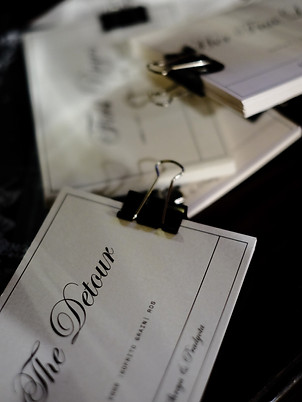
Most of my time went into managing everything surrounding the food, the content, table setup, design language, postcards, art direction, music, books, visual details, and overall experience. By the time I could focus entirely on the food itself, it was already too late. I remember tasting my first course for the first time at around noon on the event day itself. But strangely, that chaos also became exciting because it pushed me creatively in ways I hadn’t explored before. It felt like a test, not just of the dinner, but of whether Khoj as a format could adapt and survive under pressure like that.’
Has there been a moment that didn’t go as planned, a failure or a key learning while hosting?
‘Honestly, there have been a lot of failures and mess ups along the way. Running eight courses for twelve people with essentially one person managing most of it is far from ideal. But somehow, the audience rarely notices the chaos happening behind the scenes. Whenever I later explain everything that went wrong during a dinner, diners are usually shocked because from the outside, everything appeared smooth and intentional.
At this point, I’ve almost accepted that something will always go wrong during a dinner. Every event teaches you something new. There was even one time when my kitchen completely flooded because of heavy rain. The water had literally risen halfway up my legs while I was trying to continue working. Situations like that are so unexpected that you can never really prepare for them.
That’s the funny thing about this work. From the outside, it can look polished and beautiful, but behind the scenes, it’s often absolute chaos.’
Is there a story from your journey that could only exist because food was involved?
‘I think food shapes almost every part of how I see the world. I’ve never really been able to picture myself separate from it, whether that’s cooking, thinking about food, or simply talking about it all the time.
It’s become such a huge part of my perspective that my friends and family are constantly annoyed by how every conversation somehow circles back to food. No matter what someone brings up, I’ll somehow find a culinary reference point for it. At this point, food isn’t just something I work with, it’s genuinely the lens through which I process and relate to things. So when people ask me to pick one specific aspect of it that matters most to me, it becomes almost impossible because it’s woven into everything.’
