Printing a sense of place
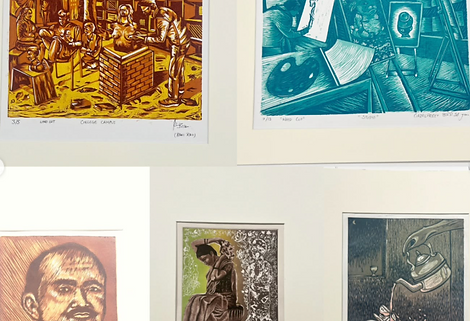
A visual and performing artist, primarily working in printmaking, Rahul, has been practicing art for over 15 years.
What began as a childhood love for drawing gradually evolved into a formal education in fine arts, where an unexpected introduction to printmaking became a lifelong practice.
What do you do and why do you do it?
I am a visual and performing artist, primarily working as a printmaker. I have been practicing art for the last 15 years, exploring painting, drawing, mixed media and printmaking, which eventually became my specialization.
Art has been part of my life since childhood.
I used to draw a lot, but I did not know then that art could become a profession. Later, I discovered the BFA program and enrolled in an art college, where I was introduced to painting, applied art, sculpture and printmaking.
While painting was initially my first choice, I gradually became drawn to the process and techniques of printmaking. What began as a chance discovery eventually became my specialization and passion.
I went on to complete my BFA, MFA and PhD in Fine Arts and have continued working as an artist throughout this journey. For me, art is more than a profession. It is something I need to do. Creating gives me a sense of peace, satisfaction and an inner connection that is difficult to find elsewhere.
With Netrika Atelier-19, a printmaking studio and community space, what gap were you trying to fill?
Netrika Atelier-19 is a dream I have carried as an artist. I believe every artist eventually dreams of having a studio, a personal space to work, think, experiment and spend time with themselves. For me, a studio is more than a workplace. It is a space for self-exploration and finding a sense of peace.
When I created Netrika Atelier-19, my intention was to build a peaceful and accessible space for printmaking, not just for myself but also for artists, students and art enthusiasts to learn, experiment and create.
The name has a personal story. Netrika is my daughter’s name, which I had chosen even before she was born. “Atelier” refers to an artist’s studio, while 19 is my date of birth and a number that has always been special to me.
Together, the name represents my daughter, my identity and my artistic journey.
The studio also houses my first printmaking press, which I received as an award. For me, receiving a machine that would allow me to continue my practice was as meaningful as the recognition itself.
What began as a small space has gradually grown, and today I hope Netrika Atelier-19 can become a place for workshops, internships, residencies and learning.
Most importantly, I want it to be a space where people can walk in, slow down, experiment and find something within themselves. For me, Netrika Atelier-19 is simply a space to work, learn, explore and find yourself.
Chandigarh has been the spine of your entire journey. What has the city given you that you don't think you could have found anywhere else?

My relationship with Chandigarh is also rooted in everyday journeys. As a student, I travelled from Ambala to Chandigarh by train and then cycled almost ten kilometres to college.
Years later, as a teacher, I continued the same journey, even using the same cycle.
Without Chandigarh, I honestly don't think I would have come this far as an artist. My journey began here when I joined the Government College of Art, Chandigarh, where I completed my BFA and MFA and received a Gold Medal.
Beyond education, the city gave me teachers, friendships, recognition and a sense of belonging. I received four State Awards from the Chandigarh Lalit Kala Akademi, along with scholarships and fellowships.
One of my most meaningful recognitions was receiving my first printmaking press through an All India open call by the Akademi.
Those experiences have found their way into my work.
Roads, trains, cycles, journeys and milestones often appear in my artwork, carrying fragments of my own story. Chandigarh gave me my first opportunity, my education and the environment in which I discovered myself as an artist.
It is not just where I studied or worked; it is a part of my identity and my artistic language.
You're a Punjabi folk dance and theatre artist. How do these two worlds, the performing and the visual, talk to each other in your work?
My connection with performing arts began in childhood, when I started participating in Ramleela in fifth standard. I continued through school and later became more involved in theatre, learning about performance, character and communication.
At art college, I discovered Punjabi folk dance, particularly Luddi, which I have continued performing since 2009.
Over the years, I have represented India through folk dance, represented Chandigarh at the National Youth Festival, and participated as a theatre artist in the Punjab Tableau for the Republic Day celebrations. For me, visual art, theatre and dance are not separate practices.
They are different languages of the same artist. Performance has influenced the way I understand movement, gesture, rhythm, space and composition, while visual art gives me another way to express what I cannot always communicate through performance. I am 36 now and still dance because it makes me happy.
I believe that when you genuinely want to do something, you find a way to make it work. I don't see my practices
as competing with each other. They run parallel to one another, each allowing me to express a different part
of myself.
What do you wish to establish in Chandigarh through your work?
What I wanted to establish was a dedicated space for printmaking connected to Chandigarh. Although Netrika Atelier-19 is around 45 kilometres away, its location connects Chandigarh, Punjab, Haryana and Delhi, placing it within a larger creative network around the city.
The idea was to create a space where printmaking could continue beyond art college, allowing artists and students to learn, experiment and develop their practices.
Today, I am happy to see printmaking growing across Chandigarh and the surrounding region, with new studios emerging and former students beginning to establish their own spaces.
When I was a student, there were very few senior printmakers around us to look up to. I wanted to change that, and it is meaningful to see my students carrying
the practice forward.
The same printmaking machine I received as an award in 2022 has since been awarded to four of my students.
Some have gone on to study in Baroda, receive Gold Medals and work professionally while continuing their printmaking practices.
For me, the goal is not simply to build one studio, but to create a culture and continuity of printmaking. Through Netrika Atelier-19, I hope to support exhibitions, workshops and eventually scholarships for young artists.
Ultimately, I want to contribute to a sustainable printmaking ecosystem around Chandigarh, connecting artists, students, learning and opportunities.
If the next generation takes it further than I could, that would be the real success of my work.
What does a finished print feel like in your hands?
For me, the most satisfying moment in printmaking is when you finally lift the paper from the block and see the print for the first time.
There is always a sense of suspense throughout the process. Whether working with woodcut, etching, lithography or collagraphy, the final image remains hidden until the print is pulled. After hours of sketching, carving, etching, inking and preparing the paper, there is still that question: “How will it actually look?”
Then comes the reveal.
Slowly lifting the paper and watching the image appear brings a mix of excitement, curiosity, relief and fulfilment. That suspense is what makes printmaking special to me.
The first reveal is not just about seeing the finished image, but about witnessing the result of an entire journey from the first sketch to the final impression.
Complete the sentence for us: “When life gives you tangerines…”
That’s a funny question! If life gives me tangerines, I’ll make prints out of them and share them with the world!